
Startling but useful: users who sign transactions without a clear readout of token movements and fees are the single biggest behavioral risk in web3 wallets. That’s not a blame game — it’s a mechanism-level observation. Signing a transaction is an authorization; when the contents are opaque, you’re effectively blindfolding yourself in a high‑stakes market. Rabby’s Chrome extension makes that opacity visible by simulating transactions and surfacing the exact token balance changes and estimated fees before you sign. For DeFi power users in the US who move capital across chains and contracts, that one feature often outweighs incremental UX niceties offered by other popular wallets.
This piece compares Rabby’s browser extension to common alternatives (MetaMask, Trust Wallet, Coinbase Wallet) from the perspective of a practiced DeFi user: who benefits from Rabby’s design choices, where the design trades security for convenience, and what limits still matter. I’ll unpack how simulation works in practice, when it helps and when it can’t save you, and give a practical heuristic for when to prefer Rabby in a multi‑chain workflow.
How Rabby’s transaction simulation and pre‑sign checks actually work
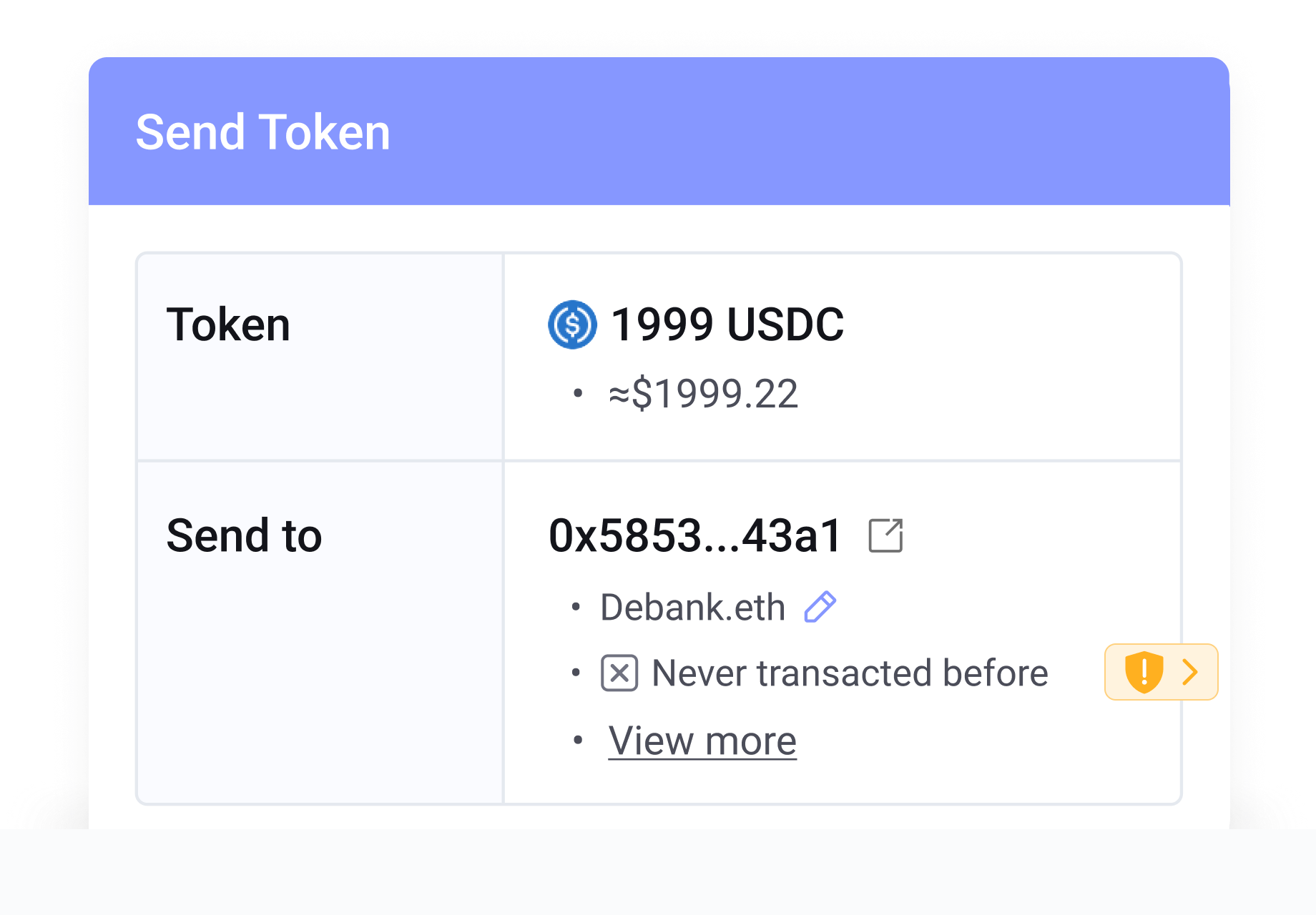
At a conceptual level, transaction simulation is simply running the proposed transaction against a blockchain state (or a reliable local model of that state) to produce an expected outcome without actually submitting it. Rabby then translates that output into human‑readable line items: which tokens leave, which tokens arrive, gas spent, and the final balance delta. It layers a security engine on top that flags risky patterns — approvals that grant unlimited spending, interactions with contracts previously marked as compromised, or transfers to zero or unusual addresses.
Why does that matter? Because many wallet exploits rely on user error during the signing step: malicious dApps craft transactions whose intended effects are different from what the user believes. Simulation converts a signing decision from “trust the UI” to “confirm the described ledger change.” For advanced DeFi flows — cross‑chain swaps, complex router interactions, or permit approvals — seeing the exact balance change is a practical inoculation against social engineering and confusing UX from dApps.
Side‑by‑side trade‑offs: Rabby vs. common alternatives
Rabby is not trying to be a one‑size‑fits‑all consumer fiat onramp. It focuses on risk reduction for active DeFi traders. Here are the main trade‑offs you should weigh:
Security-first features: Rabby’s pre‑transaction scanning, built‑in approval revocation, and simulation are explicit defenses that target blind‑signing and lingering approvals. MetaMask historically emphasizes ubiquity and ecosystem integrations; Coinbase Wallet and Trust Wallet emphasize consumer onboarding. If your daily job involves interacting with unfamiliar smart contracts, Rabby’s tooling reduces cognitive load and lowers attack surface in a verifiable way.
Hardware and institutional integrations: Rabby supports Ledger, Trezor, Keystone and others, and it integrates with Gnosis Safe, Fireblocks, and enterprise custody solutions. For power users or institutions using multi‑sig flows, that compatibility matters; it lets you keep private keys cold while still leveraging Rabby’s simulation layer for front‑end validation.
Multi‑chain convenience: With over 90 EVM chains supported and automatic network switching, Rabby removes the friction of manual network choice — a small but frequent source of errors. By contrast, other wallets demand manual chain selection or rely on dApp prompts, which can create mismatches and failed or misrouted transactions.
Limitations to accept: Rabby does not currently include a fiat on‑ramp or native staking inside the wallet. If you want to buy crypto with USD inside the extension, or stake tokens with a one‑click native flow, you’ll need third‑party services. Also, simulation is strong but not infallible: it assumes that the off‑chain model or node you simulate against matches on‑chain state at execution time. Reorgs, mempool front‑running, and complex cross‑contract interactions can still lead to outcomes that differ from the simulation.
Common myths vs reality
Myth: “A simulation makes you immune to hacks.” Reality: simulation reduces a class of user‑facing risks but does not remove systemic weaknesses. For example, if you approve a malicious spender and later a separate exploit occurs in the spender contract, simulation won’t retroactively protect those approvals. Rabby’s revocation tool helps but the root problem — excessive approvals — is a protocol and UX challenge shared across wallets.
Myth: “Automatic network switching equals safety.” Reality: automatic switching is a usability win that prevents inadvertent transactions on the wrong chain; however, automatic behavior also requires trust in the wallet’s mapping of dApp endpoints to networks. Power users should still glance at network indicators and transaction details — automation reduces friction but does not remove the need for situational awareness.
Practical heuristics: when choose Rabby’s Chrome extension
If any of these apply to you, Rabby is worth trying as your primary browser wallet: you regularly interact with new or unfamiliar dApps; you move assets across multiple EVM chains in a single session; you care about seeing exact balance deltas before signing complex router transactions; or your workflow uses hardware wallets or multi‑sig custody. The extension form factor places simulation immediately in your signing flow, which is where it does the most good.
Conversely, if your primary need is frictionless fiat on‑ramp or on‑chain staking inside the wallet, Rabby’s extension won’t replace integrated custodial services. Also, tribunals like developer tooling or certain DeFi SDKs still often assume MetaMask defaults; switching to Rabby sometimes requires a one‑time “flip” toggle to behave as MetaMask for compatibility reasons.
Where Rabby shines and where uncertainty remains
Rabby’s open‑source MIT codebase and the 2022 incident response (a swap contract exploit followed by freeze and compensation) demonstrate a pragmatic security posture: bugs happen, but response processes and audits matter. This matters to US users and institutions who want traceable remediation paths. At the same time, simulation’s effectiveness depends on accurate node data and the wallet’s ability to model pending state changes; adversarial miners, complex cross‑contract transactions, and rapid mempool dynamics can produce divergence between simulated and real outcomes. In short: simulation reduces but does not eliminate execution risk.
For teams building DeFi apps, Rabby presents a helpful signal: wallets with richer pre‑sign tooling push dApp developers toward clearer transaction design and fewer surprise multisig or approval-heavy patterns. For regulators and institutional risk officers, these wallet design choices make user consent more explicit — a small step toward more auditable consumer protections — but they do not substitute for governance or custody controls required at scale.
To install or evaluate the extension from a reliable source and read documentation before importing keys, see rabby wallet.
What to watch next (near term signals)
Watch for three developments that will change Rabby’s competitive positioning: improved on‑chain estimation under adverse mempool conditions (which would tighten simulation fidelity), broader fiat integrations via partnerships (which would close the on‑ramp gap), and deeper native staking or liquid‑staking UX (which would reduce the need for external staking flows). None of these are guaranteed; each depends on partnerships, regulatory friction in the US, and product priorities.
Also monitor how wallets incorporate formal verification and third‑party audit disclosures into the signing UI. If wallets can display provenance or audit grades for contract addresses during simulation, that would elevate the value of pre‑sign checks from advisory to actionable evidence.
FAQ
Does Rabby’s simulation prevent every kind of smart contract exploit?
No. Simulation prevents blind‑signing and exposes intent, but it cannot prevent exploits that happen after signing (for example, a later vulnerability in a contract you previously approved), nor can it change consensus‑level events like chain reorganizations. Use it as a powerful risk‑reduction tool, not as a complete safety net.
Can I use Rabby with a hardware wallet and Gnosis Safe?
Yes. Rabby offers extensive hardware wallet support (Ledger, Trezor, Keystone, CoolWallet, and more) and integrates with multi‑sig and institutional custody solutions like Gnosis Safe and Fireblocks. This lets you combine cold key security with Rabby’s pre‑sign simulation for added operational safety.
Will automatic network switching ever sign transactions on the wrong chain?
Automatic switching reduces user error, but it is not infallible. It relies on correct dApp network metadata. Always confirm the network indicator and transaction details when moving large sums or performing cross‑chain operations.
Does Rabby show active token approvals and let me revoke them?
Yes. Rabby includes a native approval‑revocation tool that helps you locate and cancel lingering allowances. This is one of the practical ways to limit exposure if a contract becomes compromised after you previously approved it.


